
The 10 most beautiful scenic routes in Italy to drive along in a supercar
There’s a sure-fire way to tell if a road is truly worth it: switch off the radio, wind down the window and listen. The roar of the engine echoing off a wall of Dolomite rock. The whoosh of the wind over Lake Como at a hundred an hour. The sudden silence of a hairpin bend suspended above the Tyrrhenian Sea, before the sound of the naturally aspirated engine fills the cabin once more. Italy is a country built to be explored by car, and some of its roads are engineering masterpieces just waiting for the right engine.
This is not a classification. It's a curated selection of ten tracks where tarmac, scenery and driving pleasure combine into something you won't forget. For each one, we've given the length, actual journey time, best time and the car from the GC Auto fleet that we consider ideal for that context. Not the fastest: the fairest.

01 Stelvio Pass — South Tyrol / Lombardy
Forty-eight numbered hairpins on stone plaques. The Stelvio needs no introduction for drivers, but it does need respect. The road connecting Prato allo Stelvio with Bormio is the second highest road in Europe with permanent asphalt, and has become the unofficial test bench of every motoring magazine on the continent. Not for the speed attainable - the limits are tight and fair - but for the quality of the curves: long, wide, with progressive visibility and a generally excellent surface from June to October.
The South Tyrolean side is the most scenic, with hairpin bends climbing up the wall like a spiral staircase. From Bormio, the profile is different: more open, with stretches of falsopiano between 2,200 and 2,500 metres where the engine breathes less but the landscape widens out as far as the Ortles Group. The best thing is to do both slopes on the same day, stopping at the top for a coffee at the refuge.
Recommended car
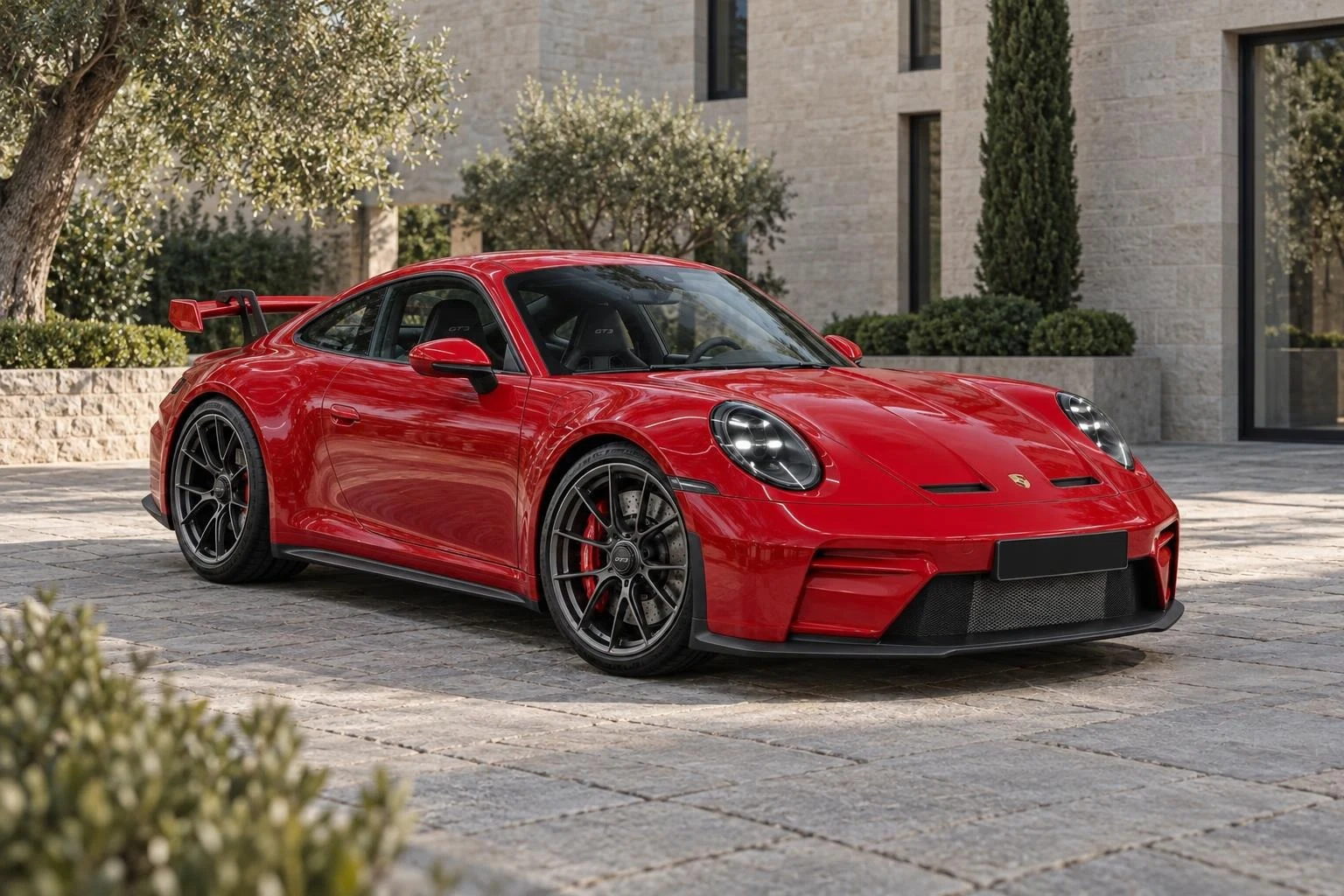
Porsche 911 GT3 - The 510 hp aspirated engine is the perfect engine for the Stelvio. Responsive, sonorous, precise in cornering. The PDK gearbox handles the continuous gear changes effortlessly, the low weight (1,435 kg) makes every bend a pleasure. No turbo lag, no hesitation: just the flat-six that rises to 9,000 rpm like a Swiss watch.
Best period: June-September. The pass closes with the first snowfall in October. Avoid weekends in August due to motorbike traffic.
02 State Road 163 (Amalfi Coast) — Campania
The SS163 is probably the most photographed coastal road in Europe, and for a specific reason: each bend reveals a different composition of sea, rock and vertical architecture. From Vietri sul Mare the road climbs immediately, threading its way between Cetara and Maiori, then gradually narrows to Amalfi and Positano. It is not a fast road and it does not have to be. Here you drive to look, to stop, to smell the lemons coming from the interior.
The carriageway is often narrow - at times only one vehicle at a time - and tourist buses occupy the whole lane. That's why you need a compact, agile car with good visibility. The real luxury on the Costiera is not power: it is the open roof and an engine that sounds good at low revs, while the Tyrrhenian sparkles two hundred metres below.
Recommended car
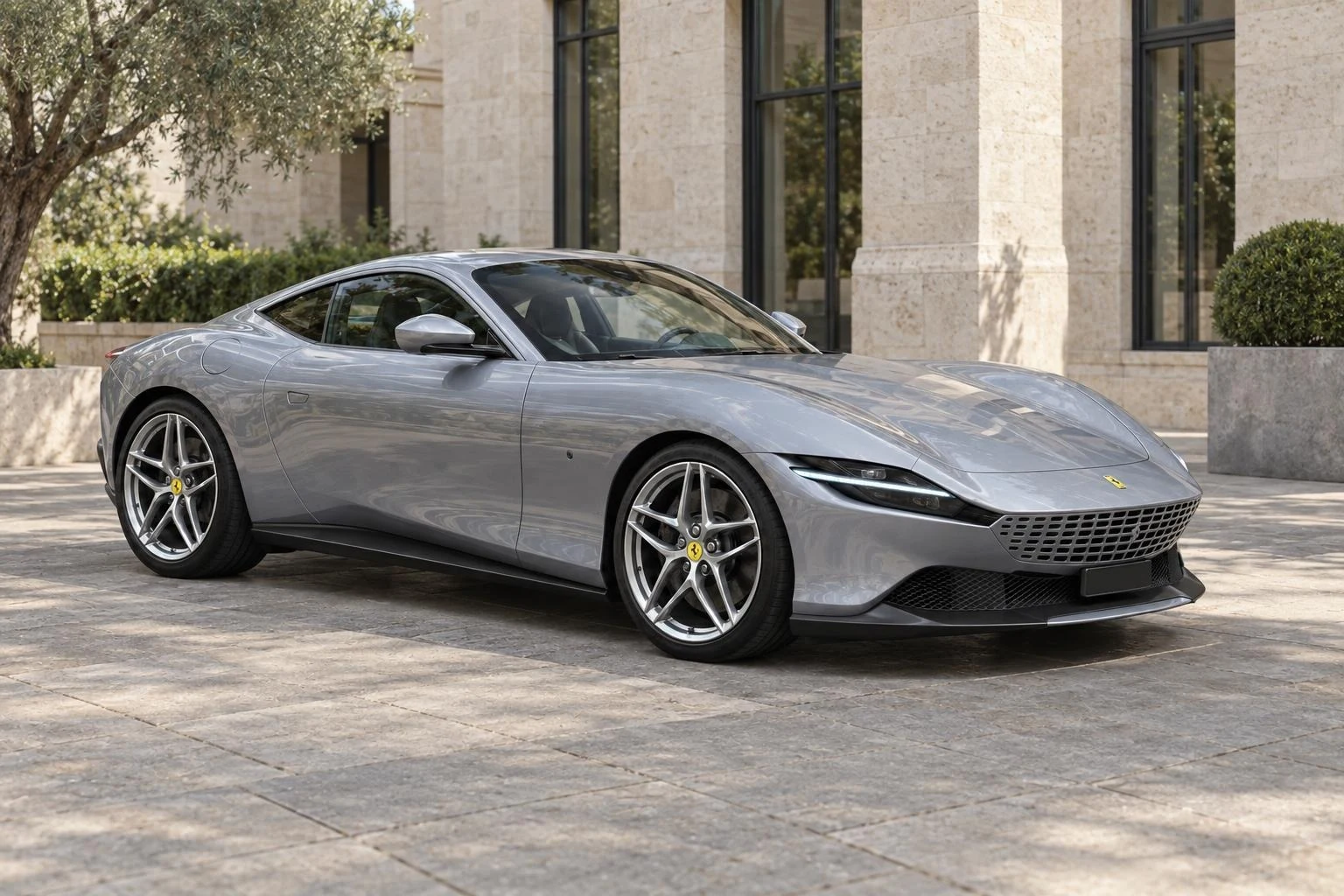
Ferrari Rome - Ferrari's most balanced gran turismo in years. With 620 hp and a wheelbase of 2,670 mm, it's compact enough for the Costiera and elegant enough for dinner at San Pietro in Positano. The hard top protects it from the midday sun; the turbocharged V8 offers generous torque even at 2,000 rpm, without ever having to raise its voice.
Best periods: April-May and September-October. Summer is crowded. Monday mornings are the quietest time of the week.
03 The Dolomite Passes Circuit: Sella, Gardena, Pordoi — Trentino-Alto Adige / Veneto
The Sella ring is the most famous natural circuit in the Dolomites. Four passes circling the massif of the Sella Group, four different valleys, four changes of light in the space of two hours. You start in Canazei, climb to Pordoi between the walls of Sass Pordoi, descend to Arabba, climb to Campolongo and then to Gardena with Sassolungo dominating the background. At Passo Sella, if the sky is clear, you can see the Marmolada.
The track is a succession of wide curves at medium speed, with asphalt almost always in good condition. The gradients are moderate but constant: the engine is always working, there is not one metre of flat straight. It's the kind of driving that rewards fluidity, not brute power. A car with good traction and adaptive suspension makes all the difference.
Recommended car
Lamborghini Huracan Evo Spyder - The 640 hp naturally aspirated V10 with an open roof is the ultimate experience in the Dolomites. All-wheel drive handles the damp morning stretches with no uncertainty, and the sound of the decacylinder between dolomite walls is something no audio system will ever be able to reproduce. Small overall dimensions for a supercar (4,520 mm), acceptable visibility.
Best time: mid-June-early October. In July and August early morning (before 8am) or late afternoon to avoid cyclists and campers.
04 SP38 on Lake Como — Lombardy
The western shore of Lake Como is a sequence of villages, Art Nouveau villas, stone walls skimming the water and legendary hotel entrances. The SP38 runs between Colonno and Menaggio via Sala Comacina, Ossuccio, Lenno (where Villa del Balbianello overlooks the lake from a promontory) and Tremezzo, where the Grand Hotel has been a monument to hospitality since 1910.
The road is narrow and requires attention, but the pace is slow by choice: here you drive for the pleasure of arriving, not for the rush to leave. The tunnels carved into the rock create a play of light and shadow that becomes cinematic with the open roof. After Menaggio, those who wish can continue towards the Swiss border and Lugano (45 km), turning the day into a small cross-border grand tour.
Recommended car
Ferrari Portofino M — The Ferrari convertible best suited to narrow roads: a 2+2, with a retractable hardtop that closes in 14 seconds, and a twin-turbo V8 producing 620 CV – power you’d only use 10 per cent of here, but which makes its presence felt in the deep rumble through the tunnel. Elegant without being flashy. Incidentally, the name comes from another Ligurian village on the other side of the Apennines.
Best period: April-June and September. Avoid Easter weekend and May bridges for traffic to Switzerland.
05 SS125 Eastern Sardinia — Sardinia
The Orientale Sarda is the road that Sardinians know and tourists ignore. The section between Tortoli and Dorgali, passing through the Genna Silana pass at 1,017 metres, is one of the wildest and most beautiful routes in the western Mediterranean. The Mediterranean scrub gives way to holm oaks, then to the white limestone of the Supramonte, then suddenly to emptiness: the sheer drop to the Gulf of Orosei that takes your breath away every time, even at the tenth.
There are hundreds of bends - literally more than a thousand on the complete route - but the surface is good, the traffic is almost absent on weekdays, and the landscape changes every five minutes. From Genna Silana you descend towards Cala Gonone with a series of hairpin bends reminiscent of the Stelvio in miniature, but with the sea instead of a glacier. A road that alone justifies the trip to Sardinia.
Recommended car
Porsche 718 Spyder - The 420 hp flat-six in the body of an open barchetta. On the Orientale Sarda the featherweight (1,420 kg) and a real advantage: every curve is an invitation, every stretch a reward. The six-speed manual gearbox, for those who appreciate it, adds a level of involvement that paddles cannot replicate.
Best period: May-June and September. In the middle of summer, the heat is intense and herds occupy the roadway in the early hours of the morning.
06 Strada della Forra (SP38) — Lombardy / Lake Garda
Winston Churchill called it “the eighth wonder of the world”. James Bond staged a chase there in *Quantum of Solace*. Six and a half kilometres of road carved into the gorge of the Brasa stream, passing through natural tunnels, with vertical drops overlooking Lake Garda and sections where the sky becomes a narrow slit between the rock faces. The Strada della Forra links the western shore of the lake to the Tremosine plateau, and is unlike any other road in Italy.
The carriageway is extremely narrow — less than three metres wide in places — and requires a compact car. It is not a road for speeding: the pleasure lies in the scenery, in the roar amplified by the tunnels, and in the light filtering down from above as if in a limestone cathedral. It takes fifteen minutes to drive along it, but you’ll remember it for years to come.
Recommended car
Porsche 718 Boxster — Compact (4,379 mm), agile, with a mid-mounted engine that responds instantly to every steering input. The open-top is essential here: hearing the echo of the turbocharged boxer engine bounce off the gorge walls is a unique auditory experience. And it’s the right Porsche for a road where precision matters, not power.
Best period: April-October. Closed occasionally for landslides in winter. Tuesday and Wednesday mornings are the quietest times.
07 The roads of the Langhe: Alba — Barolo — La Morra — Serralunga — Piedmont
The Langhe is not a road: it is a nervous system of provincial roads connecting hills, wineries and villages in a landscape declared a UNESCO World Heritage Site. From Alba, one climbs towards Barolo on the SP3, passes through La Morra - where the belvedere offers one of the widest views in Piedmont - and descends towards Serralunga d'Alba amidst rows of Nebbiolo vines that turn fiery red in autumn.
Here the rhythm is contemplative, the curves soft, the bottom undulating like a sea of earth. You don't need power but torque: the climb between the rows of vines is continuous, gentle, insistent. The ideal car is a GT that knows how to be discreet in the Cantina Giacomo Conterno car park and at the same time gratifying on the deserted provincial roads in the late afternoon, when the grazing light paints the hills.
Recommended car
Aston Martin DB11 — The AMG-derived twin-turbo V8 delivers 535 CV with a linear power delivery that suits the pace of the Langhe perfectly. The leather and Alcantara interior is like a lounge. The 270-litre boot easily accommodates crates of Barolo. And when it pulls away from the winery, the sound of the Aston turns the winemakers’ heads.
Best time: September-November for the grape harvest and white truffles. The Alba Truffle Fair (October-November) is an event worth the trip.
08 The Great Dolomites Route: Bolzano — Cortina d’Ampezzo — Trentino-South Tyrol / Veneto
Opened in 1909 to connect Bolzano a Cortina d’Ampezzo, the Great Dolomite Road and the route that invented the concept of the “scenic road” in the eastern Alps. Three major passes, two and a half hours of driving, a complete catalogue of Dolomite geology: from the Catinaccio at sunset (the Enrosadira tinges the walls pink) to Sass Pordoi, from the Marmolada that appears and disappears in the clouds to the Cinque Torri before Cortina.
The road is wide, well maintained, with sweeping curves and generous visibility. Unlike the Stelvio, here the traffic is more distributed and the gradients gentler. It is a route that can be enjoyed with a car that is fast but not extreme: the GT that eats up kilometres without tiring, that holds its course at two thousand metres and arrives in Cortina with the driver still fresh for dinner at the Tivoli.
Recommended car
McLaren GT - The “trip” of the McLaren range. 620 bhp, mid-engined, but with a 150-litre front boot and a 420-litre rear that make it a true GT. The interconnected hydraulic suspension absorbs the imperfections of the Alpine surface with a competence that belies the brand's racing DNA. And in corners, when needed, the McLaren remembers what it can do.
Best time: June-September. Passo Pordoi closes with the first snow. July offers the longest days to complete the route at leisure.
09 The Riviera dei Fiori: Sanremo — Ventimiglia — the French border — Liguria
The road from Sanremo It leads towards France and the natural border between the Ligurian Riviera and the Côte d'Azur, and by car the passage is almost imperceptible: the light is the same, the scent of pine trees and saltiness is the same, only the language on the signs changes. The Aurelia Bis and the old coastal Via Aurelia run parallel, and those who have time choose the second: narrower, slower, but with the sea three metres away.
From Ventimiglia you enter France at Menton, pass Cap Martin, Roquebrune, and in forty minutes you are at Monaco. GC Auto logistics allow pick-up in San Remo and drop-off in Nice or Monaco (or vice versa), turning this stretch into the first chapter of a longer road trip on the Côte d'Azur.
Recommended car
Ferrari 296 GTS - The combined 830 hp V6 hybrid is the Ferrari of the moment: compact, super-fast, but also capable of electrically driving through the historic centres of Sanremo and Menton without a sound. The retractable hardtop is perfect for the Riviera climate. And Ferrari red on the Monaco waterfront never goes unnoticed - but with the right discretion.
Best periods: March-June and September-October. The Sanremo Festival (February) and the Monaco GP (end of May) add context. Summer weekend traffic is busy.
10 The Cilento Coast: Agropoli — Palinuro — Campania
The Costiera Cilentana is Campania's best-kept secret. While the world stops at the Amalfi Coast, south of Salerno Another stretch of coastline begins: wilder, less developed, with coves accessible only on foot and fishing villages where, in the evening, you can dine at the harbour on fish that has just been unloaded. From Agropoli, the road climbs inland, passing through Castellabate (the village featured in *Benvenuti al Sud*), descends towards Acciaroli, then climbs up to Palinuro with its natural arch and sea caves.
The track has a different rhythm from the SS163: wider, less traffic, with bends that open up onto views where there is nothing between you and Africa. The road is in good condition and the traffic, outside August, is almost non-existent. And the kind of route where a luxury SUV makes sense: dirt back roads to hidden beaches, comfort on transfers, space for a week's worth of luggage.
Recommended car
Lamborghini Urus — 650 CV, generous ground clearance, all-wheel drive, and a commanding presence that finds its natural setting at the port of Acciaroli. The Urus is the SUV that turns every detour down a dirt track towards a hidden cove into an adventure, and every arrival in a village into an event. Space for four people and luggage, with no compromises.
Best period: May-June and September. Cilento experiences its best season when the Amalfi Coast is already congested.
How to organise your road trip with GC Auto
Every car in this selection can be collected via GC Auto’s personalised delivery service. It’s simple: choose the model, tell us where you’d like to collect the car — airport, hotel, private villa — and our team will sort out the logistics. No rental desk, no queues, and no “Panda” from the car park that has ‘almost the same features’.
For those who want to combine several roads from this list in one trip, GC Auto handles the multi-cup logistics: collection at Milan, drive to the Stelvio and the Dolomites, return to Cortina or Venice. Or collection at Naples, Amalfi Coast and Cilento, returns to Rome. A change of car on the way is possible: a Porsche 911 GT3 for the Alpine passes, then a Ferrari Portofino M for the descent to the lake. Each combination is managed by the dedicated contact person, with a single contact person from quotation to return.
Transfers between different cities carry an additional cost that depends on the distance and on the availability of the model. During office hours the GC Auto team replies within 15 minutes and prepares a detailed quote with every item shown clearly: rental, insurance, included kilometres and any one-way supplement.
For multi-day road trips, we recommend booking at least two weeks in advance, especially in June-September when demand for convertible models is highest. The models in this selection - 911 GT3, Huracan Evo Spyder, Ferrari Rome, Portofino M — these are among the most popular in the fleet and availability varies from week to week.
Your road trip starts here
You choose the route, you choose the car. We take care of the rest: delivery wherever you want, multi-car logistics, a dedicated contact person from first contact to return.
Book now
 Italian
 English
 Spanish
 Russian
 Arabic