
Ferrari Roma vs Porsche 911 Carrera: two grand touring philosophies compared
They face each other from opposite sides of the Alpine arc, and represent two radically different ways of understanding grand tourism. The Ferrari Rome is a 2+ coupe with a Mediterranean soul, designed to cross Europe with elegance and 620 twin-turbo V8 horsepower under the bonnet. The Porsche 911 Carrera is the evolution of an untouchable formula since 1963: rear-mounted boxer engine, surgical driving position, German saloon reliability. The customer who considers both is not choosing a car: he is choosing a philosophy of travel. This comparison, calibrated on the actual rental of a few weeks a year, serves to understand which one fits best with one's way of travelling.
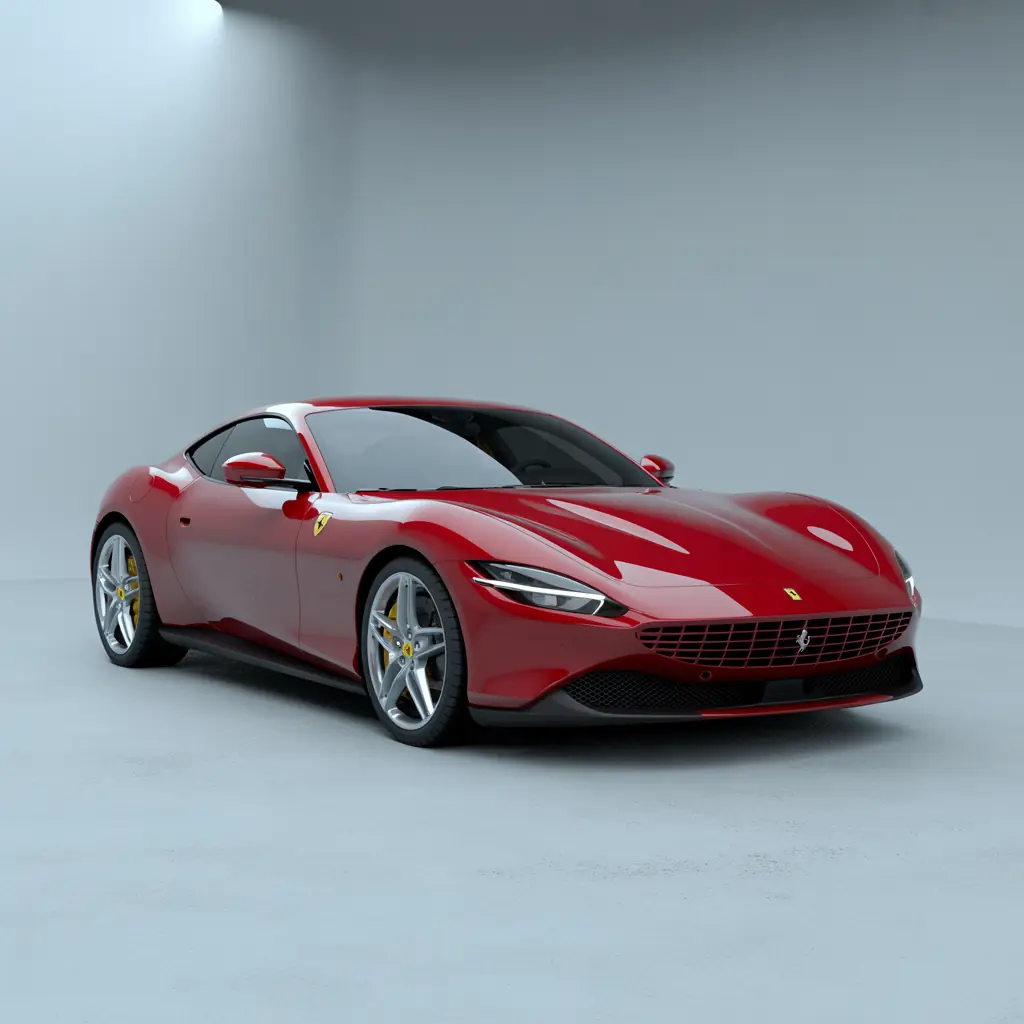
Design: la dolce vita versus the German icon
The Roma is the most successful chapter in Flavio Manzoni's recent design language. No aggressive air intakes, no aerodynamic appendages in sight, a smooth front end dominated by the large honeycomb grille that divided critics at its 2019 debut and has now become a stylistic signature. The silhouette recalls the concept of a 250 GT Lusso 2+2 reinterpreted for the twenty-first century: long bonnet, low roofline, short tail that closes with four circular tailpipes drowned in the bumper.
The 911 Carrera, in the 992.2 generation launched in 2024, continues the craft of varying a theme without betraying it. The roofline remains the same as it has been since 1963, the round headlamps remain round, the tail lifts a small active spoiler that pulls out at high speed’. It is a car that does not want to impress the general public: it wants to be recognised at first glance by enthusiasts, and it does so with a formal rigour that has turned Stuttgart into a paradigm.
On a square like the one in front of the’Hotel Splendido di Portofino the Roma garners different looks: customers taking photos, passers-by stopping to ask about the model. The 911 a Portofino is the impossible challenge: everyone knows it, few can distinguish a Carrera from a GTS. Two opposing presence strategies, both legitimate.
Engine and sound: Ferrari twin-turbo V8 or Porsche six-cylinder boxer
Under the Roma's front bonnet works the 3.9-litre twin-turbo V8 F154 BH, derived from the unit that won four International Engine of the Year awards. It produces 620 hp at 7500 rpm and 760 Nm of torque available from 3000 rpm. The response to the pedal is immediate thanks to low-inertia turbines, but the character remains that of a turbocharged Ferrari: the sound gradually rises, with a metallic timbre that in the tunnels of the Brenner motorway becomes almost symphonic.
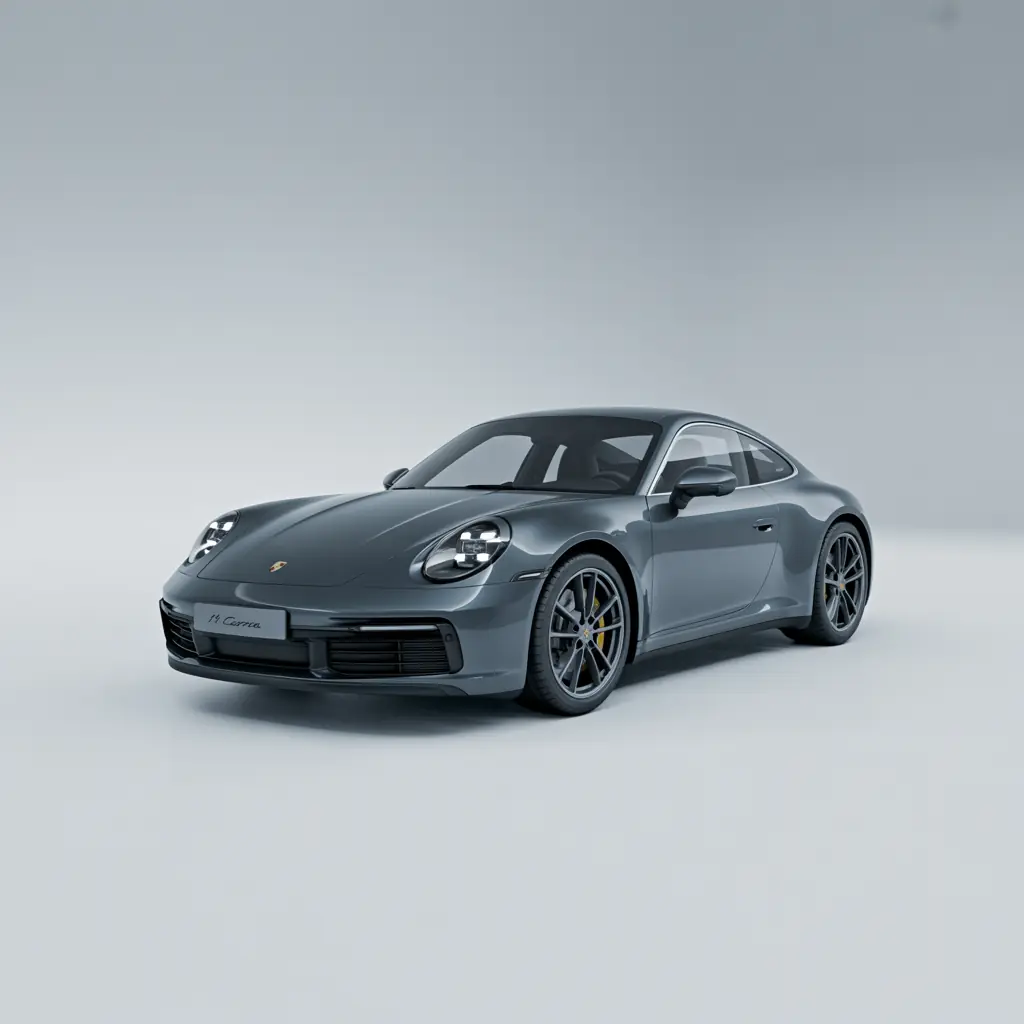
The base 911 Carrera 992.2, and above all the Carrera T that more and more customers choose to hire for its balance, mounts the 3.0-litre flat-six biturbo with flat architecture inherited from six decades of development. The T version claims 385 hp at 6500 rpm and 450 Nm of torque, apparently more modest numbers but balanced by a weight of 1478 kg, almost identical to the Ferrari. The sound of the German boxer has never been as theatrical as the one from Maranello: it is a mechanical buzz that grows nastily towards the red zone, with that unmistakable timbre that comes from the alternating ignition of opposing cylinders.
The power difference, 235 hp, is abysmal on paper. In the real world it's much less perceptible than you'd expect: the 911 has a power-to-weight ratio of 3.8 kg per horsepower against the Roma's 2.4, but the German rear-wheel drive and the mass concentrated on the drive axle give a responsiveness that Ferrari's long front end, by design choice, doesn't chase.
On the road: comfort, precision and long distance
An honest grand touring test is done on long journeys. The Roma, in Comfort configuration, filters out the roughness of the A1 motorway between Florence and Rome with a composure that no previous Ferrari had achieved. The eight-speed DCT gearbox stays in eighth gear at 130 km/h at just over 1,800 rpm, and the Daytona comfort seats allow four-hundred-kilometre stages without fatigue. It is the car that most closely resembles, today, the original Ferrari 456 or 612 Scaglietti concept: a coupe for long European transfers.
The 911 plays another league. The PASM set-up in Normal mode is drier than the Roma, but never aggressive. On stretches like the Lake Como o the Route des Grandes Alpes from Thonon to Menton, the 911 restores a dialogue with the road that the Ferrari, designed to relax, deliberately softens. The Porsche steering has a consistency that no one in the world can replicate: constant information on the centre, increasing load in the crease, zero flou. Those who arrive in the Carrera at the Bernina Pass in the evening and leave the next day for the Fluela Pass have in their hands a car that seems sculpted for that context.
In terms of motorway stability above 200 km/h, the Roma retains an advantage thanks to its longer wheelbase (2670 mm against the 911’s 2450 mm) and aerodynamic penetration coefficient designed for fast German cruising. In terms of agility between bends the 911 remains an absolute reference in its category, inherited from its rear overhang architecture that no modern competitor has wanted to copy.
Roominess and boot space: which is more practical indeed
Both are sold as 2+2, both lie differently. In the Roma, the rear seats seriously only accommodate children or soft luggage; an adult over six feet tall finds them unsuitable for journeys over half an hour. The Roma's rear boot claims 272 litres, enough for two rigid cabin trolleys and a weekend bag. Folding down the rear seatbacks brings it up to around 345 litres.
The 911 Carrera coupe adopts a radically different solution: 132 litre front luggage compartment (a fairly regular frunk for a trolley and overnight bag) and rear seats that fold down to create an additional 260 litres or so at the rear, on an uneven floor. In practice, two people travelling from Monaco in Saint Moritz with luggage for six days are better off in Rome; a couple with an eight-year-old child in a booster seat are better off in the 911 because the child's back rests against something solid.
For customers who favour overdrafts, it is worth considering two alternatives. The Ferrari Portofino M and the Ferrari California T offer the retractable hard top while maintaining the Roma's 2+2 philosophy. On the German front, the Porsche 911 Targa remains the most elegant answer to the convertible-non-cabrio concept, with its aluminium roll cage that is now a design icon.
Stage presence: where and when they stand out
A Ferrari Roma in front of the Grand-Hotel du Cap-Ferrat, or in the courtyard of the Hotel de Russie in Rome on Via del Babuino, attracts a specific quality of attention: recognisable as a Ferrari, not ostentatious like an SF90 or an 812. It is the choice of customers who want to be noticed by experts and remain discreet for everyone else. During events such as the Monaco Grand Prix or the week of the Cannes Film Festival, it is the car that enters the paddock without flashing yellow passes.
The 911 has a different destiny. In Zermatt or Saint Moritz, the black or graphite silver Carrera is almost part of the urban landscape: there are so many of them, so transgenerational, that they almost become invisible. This, for many Porsche renters, is precisely the reason for their choice. An entrepreneur renting the 911 for ten days in the Engadin wants to drive an exceptional car without the valet at Badrutt's Palace treating it as an event. German understatement is a service, not a fault.
There are, however, contexts in which the 911 is transformed. During the historic Mille Miglia, or at the Goodwood Revival, the parterre of classic and modern 911s criss-crossing each other creates a culture of belonging that no other sports brand has been able to build. The younger Roma doesn't yet have the same collecting fabric, but it's building it quickly.
Which one to hire: the verdict by use case
The choice between the two cars has little to do with spec sheets and everything to do with usage profile. Here is a grid reading that works on real customers.
Choose Ferrari Rome if: the rental is for four to ten days, the route includes long motorways, at least two five-star hotels such as Aman Venice, Belmond Villa San Michele or Bulgari Milan, and the customer wants a car that is also a gesture of style on arrival. Ideal for journeys such as Milan-Portofino-Cap-Ferrat, for a wedding between Siena and the Val d'Orcia, for a week of European offices between Frankfurt and Zurich. The typical customer is a C-level, a collector on grand tour, an entrepreneur celebrating a milestone.
Choose Porsche 911 Carrera se: The rental includes real active driving, i.e. Alpine passes, mountain sections, Stelvio, Gavia, Fluela, Grossglockner, or circuits such as Spa-Francorchamps or Nurburgring on a free day. The typical customer is a technical enthusiast, a former amateur racer, a German or Swiss customer who already knows the brand and wants the latest generation without fuss. It's also ideal for those who regularly hire cars for long distances: the 911 consumes less, is easier to park below a thousand metres and can be left in the care of any hotel valet without explanation.
There is a third case, increasingly common among GC Auto customers: the mixed rental. Ferrari Roma for the first three days in the city’ and hotel, 911 Carrera or Targa for the next four on the roads. Hotel delivery and replacement pick-up make this possible without friction, and it is probably the smartest way to experience both philosophies on the same trip.
Book Ferrari Rome or Porsche 911 with GC Auto
Customised delivery to hotel, private airport or villa in over 290 European cities. Top-tier fleet, multi-trip logistics, dedicated service. Tell us where, when and for how many days: we build the rental around your itinerary.
Hire Ferrari Rome Rent a Porsche 911 Italian
  English
  Spanish
  Russian
  Arabic